Short answer: The Yampa River is the last major free-flowing tributary left in the Colorado River system. It’s wild, undammed, and running on nothing but spring snowmelt through Dinosaur National Monument. A Yampa rafting trip is unlike anything else in the region because you actually raft two rivers in one journey: the free-flowing Yampa, then the dam-controlled Green River after the two meet at Echo Park. Trips run 4 or 5 days, cover about 72 miles from Deerlodge Park, Colorado to Split Mountain, Utah, and only run during a short window each spring.
Key Takeaways
- The Yampa is the last large free-flowing river left in the Colorado River system. No dam controls it.
- A Yampa trip is two rivers in one: you float the Yampa, then continue down the Green River after the Echo Park confluence.
- The season is short and snowmelt-driven, running roughly late April through early July, with peak flows in May and June.
- Warm Springs Rapid, the trip’s signature challenge, didn’t exist until a single flash flood remade the riverbed overnight in 1965.
- The canyon holds nearly 700 years of human history, from Fremont-era rock art and Mantle’s Cave to Old West outlaw hideouts, and the river-running pioneers who first ran it commercially.
Two Rivers, One Trip
Every other major river in the American West has been tamed, dammed, regulated, scheduled around power generation and irrigation demand. The Yampa is the exception. It rises and falls with the snowpack exactly as it has for thousands of years, which means no two trips down it are ever quite the same.
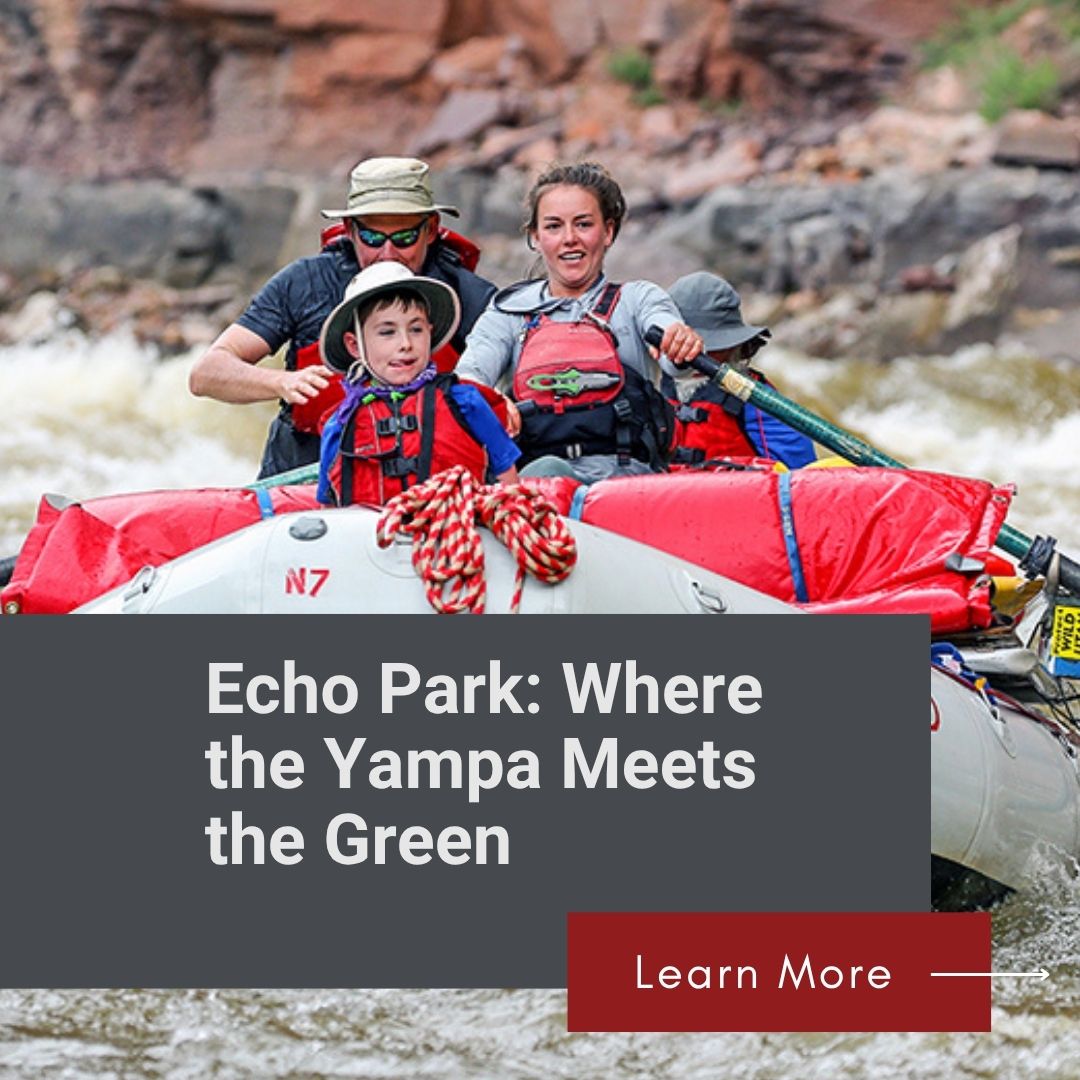
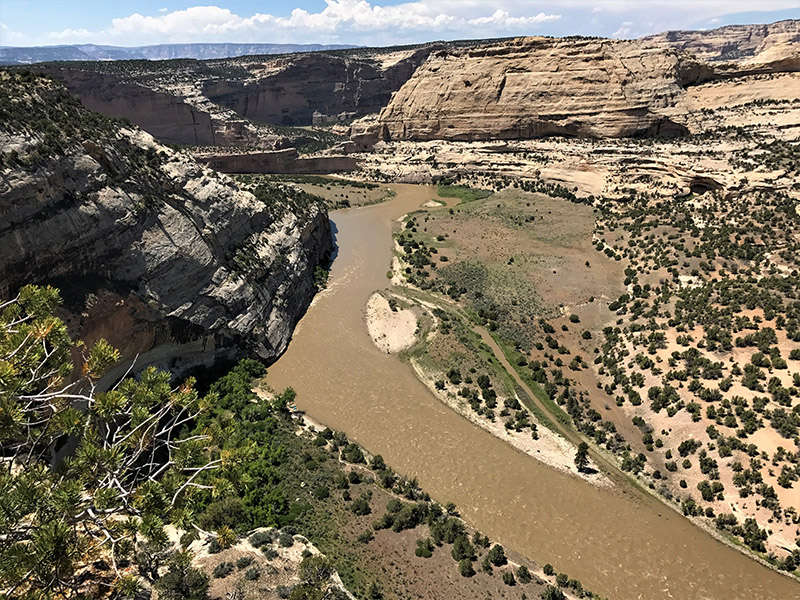
Here’s the part most people don’t expect: your trip doesn’t end when the Yampa does. After roughly 46 miles, the Yampa pours into the Green River at Echo Park, beneath the towering landmark called Steamboat Rock. From there, your trip continues down the Green through Whirlpool Canyon and Split Mountain Canyon to the take-out. One trip, two rivers, two distinct canyons. It’s a combination no other outfitter in the region can offer.
The Journey: Deerlodge Park to Split Mountain
The trip puts in at Deerlodge Park in northwest Colorado and takes out at Split Mountain in Utah, a run of about 72 miles through the heart of Dinosaur National Monument. The canyon changes character as you go. Open desert narrows into a box canyon, and by the third day the rock formations reach their high point at the Grand Overhang and Tiger Wall, a sheer sandstone cliff striped like its namesake. Boaters traditionally lean over and kiss the wall for good luck as they float past.
Warm Springs Rapid: Born in a Single Night
For most of its length, the Yampa is friendly Class II and III water, but it has one true test, and it wasn’t always there. Before June 10, 1965, Warm Springs was little more than a ripple, notable only for its scenery. That changed overnight when a storm that longtime guide George Wendt described as biblical broke over Starvation Canyon and dumped an estimated 33 million pounds of rock and debris into the river, damming it in an instant.
Wendt himself was camped at Warm Springs that day and took shelter in an outhouse as the earth around him turned to raging slurry. Upstream, guides Al Holland and Les Oldham were leading a group of Boy Scouts down a river they knew as calm, easy water. Oldham, confident in the stretch, had taken off his life vest. When the group reached what used to be a minor riffle, the newly formed rapid threw him overboard. His body was recovered seventeen days later.
News of the new rapid spread quickly through the boating community. In the decades since, Warm Springs has settled into the form guides run today, still demanding real respect, still capable of flipping a boat, but well understood by the guides who run it every season. It remains one of the biggest named rapids in the entire Colorado River system, and it’s the story every guest asks their guide to tell again around the fire that night.
The Fight to Save the Yampa
The Yampa’s wildness isn’t an accident of geography. It survived a direct threat. In the early 1900s, a wave of dam-building swept the American West on the belief that any river could and should be harnessed. In that spirit, the federal government proposed the Echo Park Dam, a structure that would have flooded the entire canyon this trip runs through today, drowning Steamboat Rock and everything upstream.
The dam very nearly happened. What stopped it was, in part, a single family’s rafting trip. An LA family floated the Yampa, fell in love with the canyon, and carried the story of the proposed dam home with them, where it reached David Brower and the Sierra Club. What followed was the first nationwide grassroots environmental movement in American history, and it worked. The dam was never built, and the Yampa remains, to this day, the last major undammed tributary of the entire Colorado River system.
That preserved wildness has real ecological consequences. Because nothing regulates its flow, the Yampa still floods and recedes with the seasons the way rivers did before dams existed, and in the 1970s scientists used the canyon to study some of North America’s last nesting Peregrine Falcons, part of a tagging and tracking program that helped the species recover. Dinosaur National Monument is also the darkest national monument in the country, a direct result of the same remoteness that kept the dam-builders out.
River-Running Pioneers: Bus Hatch and Georgie White
Long before Dinosaur River Expeditions, this stretch of river was being figured out by hand. Bus Hatch, a Vernal local, took his first exploratory run in 1931 after learning boat-building from Parley Galloway, who was himself taught by a father who pioneered a new way of running rapids: facing forward and pushing the boat through, rather than pulling against it. Hatch’s first trip was rough. He portaged Disaster Falls, flipped in Hell’s Half Mile, and salvaged little more than an onion, some potatoes, and the boat itself. Four days and eighty miles later, he was hooked. He ran his first Grand Canyon trip in 1934 and, by the 1960s, had built a company with offices in three states. He ran rivers until his death in 1967.
Georgie White revolutionized the sport in her own way. In 1945 she swam sixty miles of the Grand Canyon from Diamond Creek to Lake Mead, and by 1952 had become the first woman to row through Marble and Grand Canyons. She lashed together army-surplus rescue rafts into the first “triple rig” and ran a successful operation for 45 years, working rivers right up until her death in 1992. Together, Hatch and White are part of the reason commercial river running exists at all in this corner of the West.
Mantle’s Cave and the Fremont Culture
About 400 feet above the river in the Castle Park area sits Mantle’s Cave, a large rock shelter named for Charles and Evelyn Mantle, who ranched the area and discovered it in the early 1900s. It’s only reachable by a Yampa River trip, and it’s one of the most archaeologically significant sites in the canyon.
The Penrose-Taylor Expedition first excavated the cave in 1933, followed by more extensive digs from the University of Colorado Museum in 1939 and 1940. What they found tells a detailed story of the Fremont culture that used the cave from roughly 500 to 1255 AD: granaries holding corn and squash, stone tools and grinding stones, buckskin sandals and rabbit-fur cloth, and a remarkable ceremonial bag containing a flicker-feather headdress, slate beads, and a butterfly pendant. The site was added to the National Register of Historic Places in 1994.
Elsewhere along the canyon walls, the Fremont left behind petroglyphs and pictographs. These are simple, boxy human figures, bighorn sheep, and geometric patterns whose meaning is still debated by archaeologists. One panel, nicknamed the “wedding panel,” shows six human-height figures holding hands; another shows roughly twenty warrior-like figures rendered in tiny dots, which some believe was created by elders seeking blessings before a conflict. The Fremont thrived in this canyon for nearly 700 years, then vanished from the archaeological record for reasons that remain unknown.
Outlaw Country
The Fremont weren’t the last people to find this canyon useful for staying hidden. In the late 1800s, the remote canyons and hidden valleys around the Yampa-Green confluence became a hideout for Butch Cassidy, the Sundance Kid, and the rest of the Wild Bunch between robberies. The same isolation that drew the Fremont a thousand years earlier, difficult access, long sightlines to spot approaching lawmen, and multiple escape routes, made it ideal outlaw country. Guides still point out the exact spots where the Wild Bunch is believed to have camped and moved stolen horses through the canyon on the way downriver.
Geology: Two Billion Years of Rock
The canyon walls themselves are a stratigraphic record spanning roughly two billion years. The Yampa carves through the Mesa Verde Group as it enters Dinosaur National Monument, then cuts into Weber Sandstone, the Morgan Formation, and Madison Limestone. The Green River, which starts in Wyoming’s Wind River Mountains, cuts through a different sequence, primarily the deep red Uinta Mountain Group and the Lodore Formation that give the Gates of Lodore its name, before the two rivers’ rock layers meet at Echo Park. Erosion has exposed 23 distinct rock layers within the monument, among the most complete stratigraphic columns found in any national park.
Wildlife Along the Yampa
Because the river’s flow is entirely natural, it remains one of the last refuges for four endangered fish species native to the Colorado River system: the Colorado pikeminnow, razorback sucker, humpback chub, and bonytail. None of these ancient fish can adapt to dammed conditions. They evolved for a river that rises and falls with the seasons, which is exactly what the Yampa still does.
Above the waterline, keep watch for bighorn sheep working their way across sheer cliff faces, mule deer along the banks, and peregrine falcons and golden eagles overhead. River otters are a regular, playful presence in the calmer eddies.
Camp Life on the Yampa
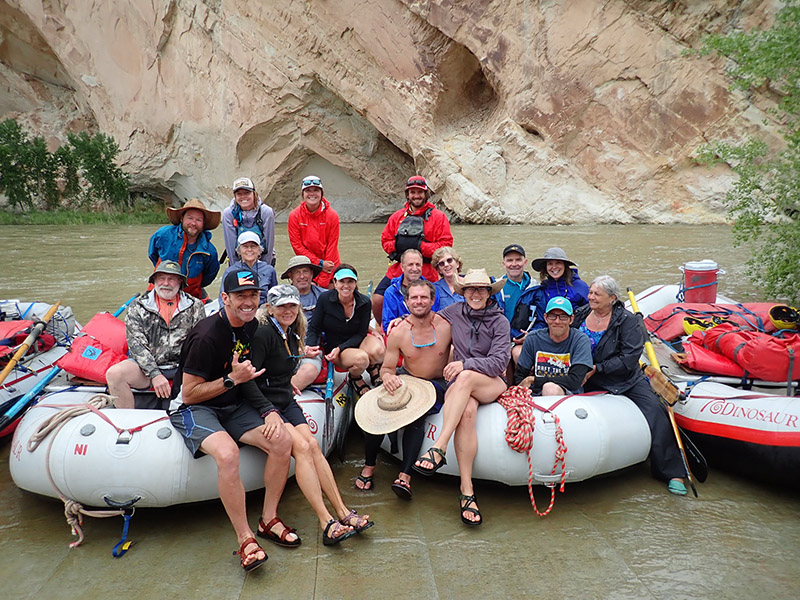
Because the river is free to shift its own sandbars, Yampa campsites feel genuinely untouched, wide sandy beaches below towering canyon walls, changing slightly from year to year and trip to trip. Your guides handle the logistics: kitchen, dining area, and tents are set up before you’ve finished exploring camp, and dinner is a real meal, not standard camping fare. Think Dutch-oven lasagna, fresh vegetables that somehow survive days on the river, and a peach cobbler guests still talk about years later.
After dark, with no artificial light for miles, the Milky Way is genuinely visible overhead. Guides share river history, outlaw stories, and canyon geology around the fire, or simply let the quiet do the talking.
When to Go
Because there’s no dam to regulate it, timing matters more on the Yampa than on almost any other river in the region. The season runs roughly late April through early July, and it moves with the snowpack, not the calendar.
| Timing | What to expect |
|---|---|
| Late April to early May | Cooler weather, rising water, fewer crowds. A wetsuit is recommended. |
| May to mid-June (peak) | Highest flows, biggest rapids, strongest current. |
| Late June to early July | Warmer days, lower water, easier swimming. Depends on the snow year. |
4-Day vs. 5-Day Trip
Both trip lengths run the identical route from Deerlodge Park to Split Mountain. The five-day trip gives you more time off the water for side hikes, longer lunches, and slower mornings in camp. Families and first-timers often prefer the extra breathing room. The four-day trip covers the same 72 miles at a fuller pace and suits a tighter calendar. Either way, you get both rivers, the Echo Park confluence, Tiger Wall, and Warm Springs.
Yampa vs. Gates of Lodore
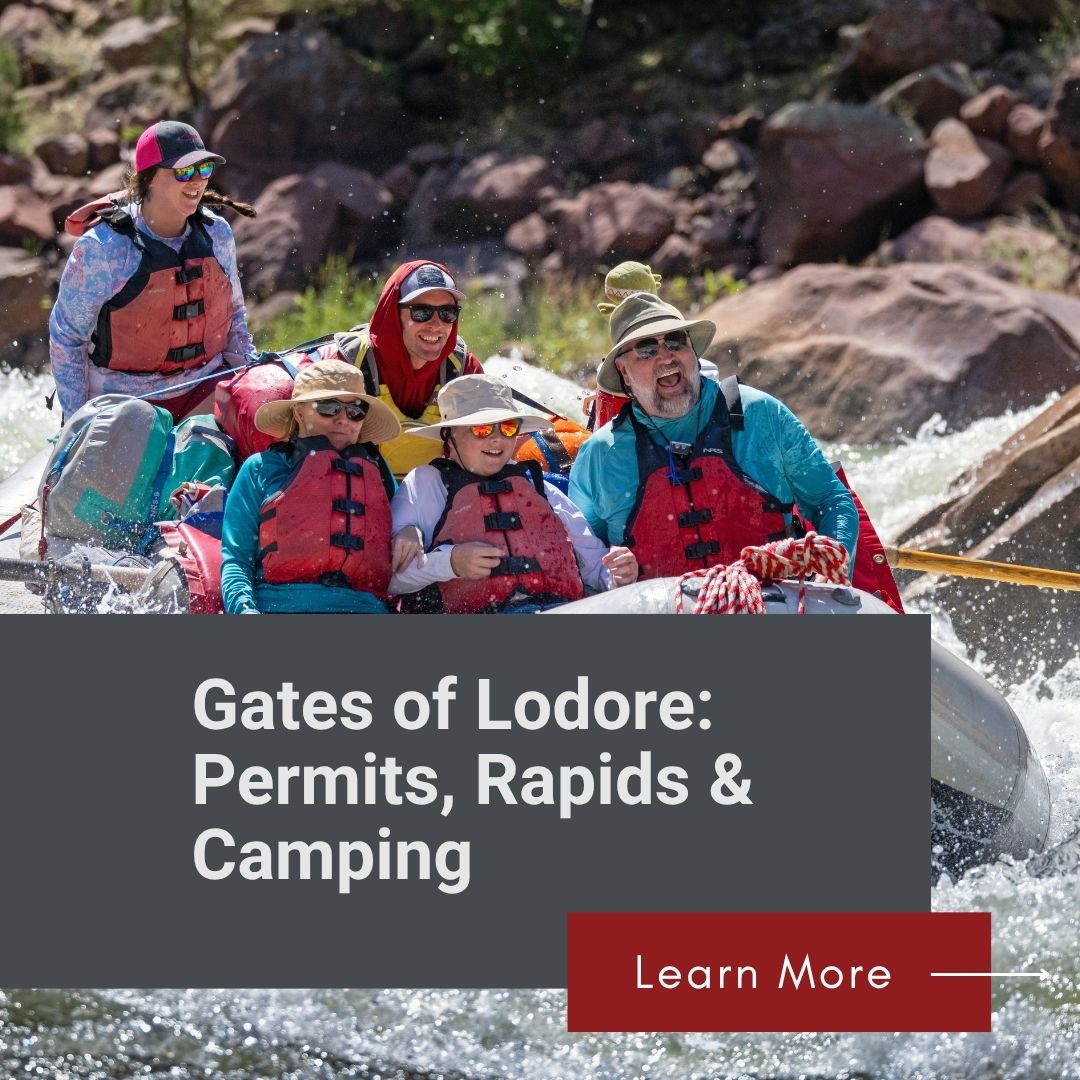
If you’re weighing which trip to book, the difference comes down to the water source. The Yampa is free-flowing with a short, snowmelt-driven season; the Green River through the Gates of Lodore is dam-controlled from Flaming Gorge, with a longer, steadier season that runs later into summer. Choose the Yampa for the wild, two-rivers experience and the thrill of a river still running on nature’s schedule.
Frequently Asked Questions
How long is the Yampa River rafting trip?
The full run from Deerlodge Park to Split Mountain is about 72 miles. We offer it as a 4-day or 5-day trip, with roughly 46 miles on the Yampa itself before the Echo Park confluence.
Why is a Yampa River trip different from other rafting trips in the area?
You raft two rivers on one trip. The Yampa is the last large free-flowing river in the Colorado system, and after it meets the Green at Echo Park, your trip continues down the Green. No other trip in the region combines both rivers.
When is the best time to raft the Yampa River?
Most trips run late April through early July, with peak flows in May and June. Because the river depends entirely on snowmelt, the exact window shifts with the snow year, so dates fill up early.
What is the biggest rapid on the Yampa?
Warm Springs Rapid, which didn’t exist in its current form until a 1965 flash flood remade the riverbed overnight. Guides scout it before every run.
Do I need rafting experience for the Yampa?
No. The Yampa is mostly Class II and III water with one Class IV rapid at Warm Springs. Guides row the boats, scout the rapids, and handle camp, so first-timers and families do well here.
How far is the put-in from Vernal?
Deerlodge Park is about a 90-minute drive from Vernal, Utah.
Reserve Your Yampa River Dates
The Yampa’s season is short and dates fill fast. As Vernal, Utah’s only locally owned and operated river outfitter, Dinosaur River Expeditions has been running this canyon for decades. Reserve your Yampa River dates today and see two rivers on one unforgettable trip.