Wonders of the Yampa River

Short answer: The Yampa River is the last major free-flowing tributary left in the Colorado River system. It’s wild, undammed, and running on nothing but spring snowmelt through Dinosaur National Monument. A Yampa rafting trip is unlike anything else in the region because you actually raft two rivers in one journey: the free-flowing Yampa, then the dam-controlled Green River after the two meet at Echo Park. Trips run 4 or 5 days, cover about 72 miles from Deerlodge Park, Colorado to Split Mountain, Utah, and only run during a short window each spring.

See what a Yampa River trip looks like from put-in to take-out.

Key Takeaways

  • The Yampa is the last large free-flowing river left in the Colorado River system. No dam controls it.
  • A Yampa trip is two rivers in one: you float the Yampa, then continue down the Green River after the Echo Park confluence.
  • The season is short and snowmelt-driven, running roughly late April through early July, with peak flows in May and June.
  • Warm Springs Rapid, the trip’s signature challenge, didn’t exist until a single flash flood remade the riverbed overnight in 1965.
  • The canyon holds nearly 700 years of human history, from Fremont-era rock art and Mantle’s Cave to Old West outlaw hideouts, and the river-running pioneers who first ran it commercially.

Two Rivers, One Trip

Every other major river in the American West has been tamed, dammed, regulated, scheduled around power generation and irrigation demand. The Yampa is the exception. It rises and falls with the snowpack exactly as it has for thousands of years, which means no two trips down it are ever quite the same.

Here’s the part most people don’t expect: your trip doesn’t end when the Yampa does. After roughly 46 miles, the Yampa pours into the Green River at Echo Park, beneath the towering landmark called Steamboat Rock. From there, your trip continues down the Green through Whirlpool Canyon and Split Mountain Canyon to the take-out. One trip, two rivers, two distinct canyons. It’s a combination no other outfitter in the region can offer.

The Journey: Deerlodge Park to Split Mountain

The trip puts in at Deerlodge Park in northwest Colorado and takes out at Split Mountain in Utah, a run of about 72 miles through the heart of Dinosaur National Monument. The canyon changes character as you go. Open desert narrows into a box canyon, and by the third day the rock formations reach their high point at the Grand Overhang and Tiger Wall, a sheer sandstone cliff striped like its namesake. Boaters traditionally lean over and kiss the wall for good luck as they float past.
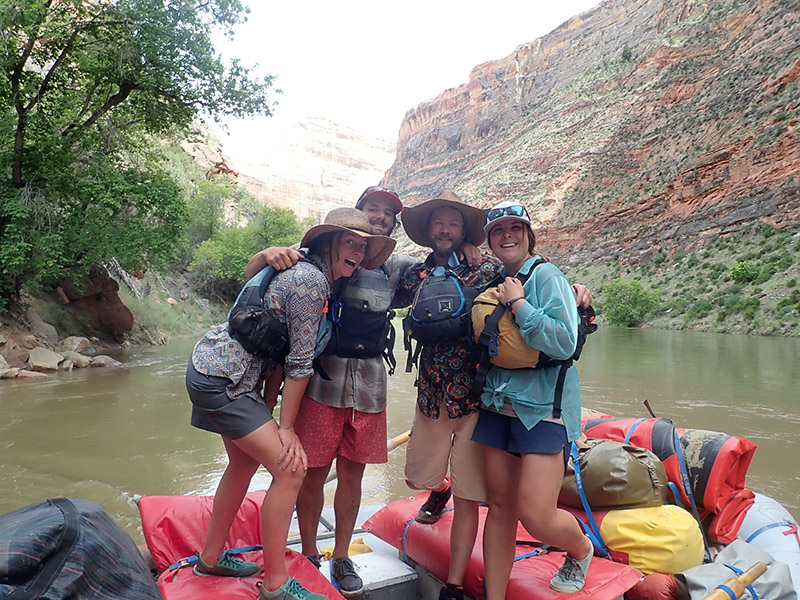
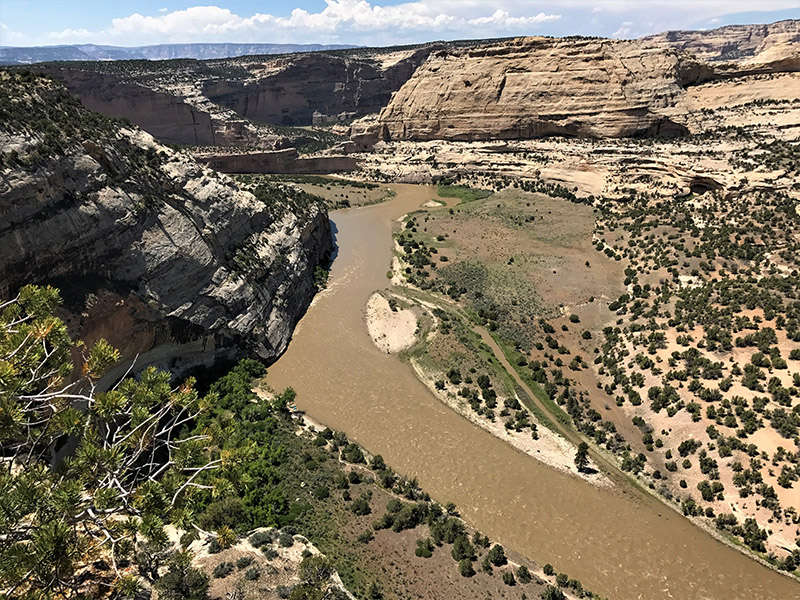
Rafting through the canyons of the Yampa River in Dinosaur National Monument
Towering canyon walls line the Yampa for most of the trip.

Warm Springs Rapid: Born in a Single Night

For most of its length, the Yampa is friendly Class II and III water, but it has one true test, and it wasn’t always there. Before June 10, 1965, Warm Springs was little more than a ripple, notable only for its scenery. That changed overnight when a storm that longtime guide George Wendt described as biblical broke over Starvation Canyon and dumped an estimated 33 million pounds of rock and debris into the river, damming it in an instant.

Wendt himself was camped at Warm Springs that day and took shelter in an outhouse as the earth around him turned to raging slurry. Upstream, guides Al Holland and Les Oldham were leading a group of Boy Scouts down a river they knew as calm, easy water. Oldham, confident in the stretch, had taken off his life vest. When the group reached what used to be a minor riffle, the newly formed rapid threw him overboard. His body was recovered seventeen days later.

News of the new rapid spread quickly through the boating community. In the decades since, Warm Springs has settled into the form guides run today, still demanding real respect, still capable of flipping a boat, but well understood by the guides who run it every season. It remains one of the biggest named rapids in the entire Colorado River system, and it’s the story every guest asks their guide to tell again around the fire that night.
White water rafting a rapid on the Yampa River
The Yampa mixes calm floating with splashy whitewater, building to Warm Springs Rapid.

The Fight to Save the Yampa

The Yampa’s wildness isn’t an accident of geography. It survived a direct threat. In the early 1900s, a wave of dam-building swept the American West on the belief that any river could and should be harnessed. In that spirit, the federal government proposed the Echo Park Dam, a structure that would have flooded the entire canyon this trip runs through today, drowning Steamboat Rock and everything upstream.

The dam very nearly happened. What stopped it was, in part, a single family’s rafting trip. An LA family floated the Yampa, fell in love with the canyon, and carried the story of the proposed dam home with them, where it reached David Brower and the Sierra Club. What followed was the first nationwide grassroots environmental movement in American history, and it worked. The dam was never built, and the Yampa remains, to this day, the last major undammed tributary of the entire Colorado River system.

That preserved wildness has real ecological consequences. Because nothing regulates its flow, the Yampa still floods and recedes with the seasons the way rivers did before dams existed, and in the 1970s scientists used the canyon to study some of North America’s last nesting Peregrine Falcons, part of a tagging and tracking program that helped the species recover. Dinosaur National Monument is also the darkest national monument in the country, a direct result of the same remoteness that kept the dam-builders out.

River-Running Pioneers: Bus Hatch and Georgie White

Long before Dinosaur River Expeditions, this stretch of river was being figured out by hand. Bus Hatch, a Vernal local, took his first exploratory run in 1931 after learning boat-building from Parley Galloway, who was himself taught by a father who pioneered a new way of running rapids: facing forward and pushing the boat through, rather than pulling against it. Hatch’s first trip was rough. He portaged Disaster Falls, flipped in Hell’s Half Mile, and salvaged little more than an onion, some potatoes, and the boat itself. Four days and eighty miles later, he was hooked. He ran his first Grand Canyon trip in 1934 and, by the 1960s, had built a company with offices in three states. He ran rivers until his death in 1967.

Georgie White revolutionized the sport in her own way. In 1945 she swam sixty miles of the Grand Canyon from Diamond Creek to Lake Mead, and by 1952 had become the first woman to row through Marble and Grand Canyons. She lashed together army-surplus rescue rafts into the first “triple rig” and ran a successful operation for 45 years, working rivers right up until her death in 1992. Together, Hatch and White are part of the reason commercial river running exists at all in this corner of the West.

Mantle’s Cave and the Fremont Culture

About 400 feet above the river in the Castle Park area sits Mantle’s Cave, a large rock shelter named for Charles and Evelyn Mantle, who ranched the area and discovered it in the early 1900s. It’s only reachable by a Yampa River trip, and it’s one of the most archaeologically significant sites in the canyon.

The Penrose-Taylor Expedition first excavated the cave in 1933, followed by more extensive digs from the University of Colorado Museum in 1939 and 1940. What they found tells a detailed story of the Fremont culture that used the cave from roughly 500 to 1255 AD: granaries holding corn and squash, stone tools and grinding stones, buckskin sandals and rabbit-fur cloth, and a remarkable ceremonial bag containing a flicker-feather headdress, slate beads, and a butterfly pendant. The site was added to the National Register of Historic Places in 1994.

Elsewhere along the canyon walls, the Fremont left behind petroglyphs and pictographs. These are simple, boxy human figures, bighorn sheep, and geometric patterns whose meaning is still debated by archaeologists. One panel, nicknamed the “wedding panel,” shows six human-height figures holding hands; another shows roughly twenty warrior-like figures rendered in tiny dots, which some believe was created by elders seeking blessings before a conflict. The Fremont thrived in this canyon for nearly 700 years, then vanished from the archaeological record for reasons that remain unknown.

Outlaw Country

The Fremont weren’t the last people to find this canyon useful for staying hidden. In the late 1800s, the remote canyons and hidden valleys around the Yampa-Green confluence became a hideout for Butch Cassidy, the Sundance Kid, and the rest of the Wild Bunch between robberies. The same isolation that drew the Fremont a thousand years earlier, difficult access, long sightlines to spot approaching lawmen, and multiple escape routes, made it ideal outlaw country. Guides still point out the exact spots where the Wild Bunch is believed to have camped and moved stolen horses through the canyon on the way downriver.

Geology: Two Billion Years of Rock

The canyon walls themselves are a stratigraphic record spanning roughly two billion years. The Yampa carves through the Mesa Verde Group as it enters Dinosaur National Monument, then cuts into Weber Sandstone, the Morgan Formation, and Madison Limestone. The Green River, which starts in Wyoming’s Wind River Mountains, cuts through a different sequence, primarily the deep red Uinta Mountain Group and the Lodore Formation that give the Gates of Lodore its name, before the two rivers’ rock layers meet at Echo Park. Erosion has exposed 23 distinct rock layers within the monument, among the most complete stratigraphic columns found in any national park.

Wildlife Along the Yampa

Because the river’s flow is entirely natural, it remains one of the last refuges for four endangered fish species native to the Colorado River system: the Colorado pikeminnow, razorback sucker, humpback chub, and bonytail. None of these ancient fish can adapt to dammed conditions. They evolved for a river that rises and falls with the seasons, which is exactly what the Yampa still does.

Above the waterline, keep watch for bighorn sheep working their way across sheer cliff faces, mule deer along the banks, and peregrine falcons and golden eagles overhead. River otters are a regular, playful presence in the calmer eddies.

Camp Life on the Yampa

Because the river is free to shift its own sandbars, Yampa campsites feel genuinely untouched, wide sandy beaches below towering canyon walls, changing slightly from year to year and trip to trip. Your guides handle the logistics: kitchen, dining area, and tents are set up before you’ve finished exploring camp, and dinner is a real meal, not standard camping fare. Think Dutch-oven lasagna, fresh vegetables that somehow survive days on the river, and a peach cobbler guests still talk about years later.

After dark, with no artificial light for miles, the Milky Way is genuinely visible overhead. Guides share river history, outlaw stories, and canyon geology around the fire, or simply let the quiet do the talking.
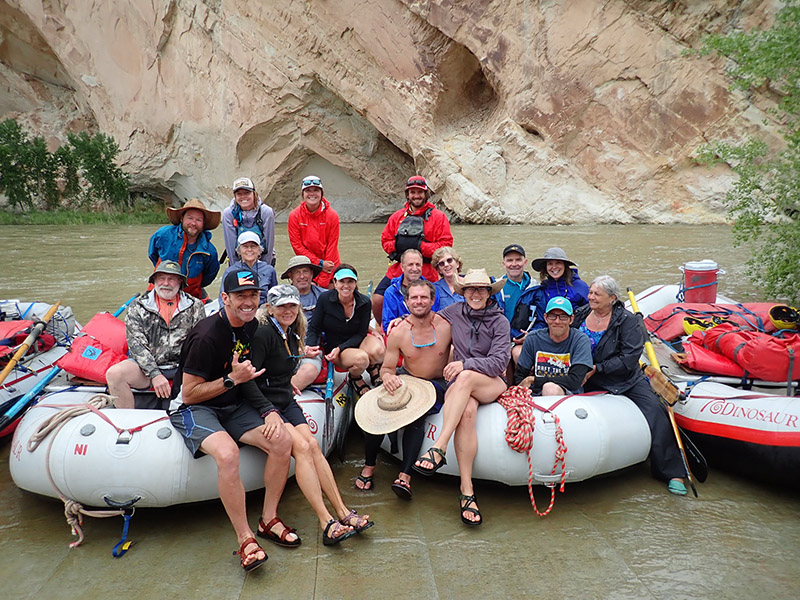
Rafters enjoying a guided multi-day trip on the Yampa River
Guides handle the rowing, camp, and meals so you can soak it in.

When to Go

Because there’s no dam to regulate it, timing matters more on the Yampa than on almost any other river in the region. The season runs roughly late April through early July, and it moves with the snowpack, not the calendar.

Flows change every year with the snowpack. Call us and we’ll tell you what the water is doing.

Timing What to expect
Late April to early May Cooler weather, rising water, fewer crowds. A wetsuit is recommended.
May to mid-June (peak) Highest flows, biggest rapids, strongest current.
Late June to early July Warmer days, lower water, easier swimming. Depends on the snow year.

4-Day vs. 5-Day Trip

Both trip lengths run the identical route from Deerlodge Park to Split Mountain. The five-day trip gives you more time off the water for side hikes, longer lunches, and slower mornings in camp. Families and first-timers often prefer the extra breathing room. The four-day trip covers the same 72 miles at a fuller pace and suits a tighter calendar. Either way, you get both rivers, the Echo Park confluence, Tiger Wall, and Warm Springs.

Yampa vs. Gates of Lodore

If you’re weighing which trip to book, the difference comes down to the water source. The Yampa is free-flowing with a short, snowmelt-driven season; the Green River through the Gates of Lodore is dam-controlled from Flaming Gorge, with a longer, steadier season that runs later into summer. Choose the Yampa for the wild, two-rivers experience and the thrill of a river still running on nature’s schedule.

Frequently Asked Questions

How long is the Yampa River rafting trip?

The full run from Deerlodge Park to Split Mountain is about 72 miles. We offer it as a 4-day or 5-day trip, with roughly 46 miles on the Yampa itself before the Echo Park confluence.

Why is a Yampa River trip different from other rafting trips in the area?

You raft two rivers on one trip. The Yampa is the last large free-flowing river in the Colorado system, and after it meets the Green at Echo Park, your trip continues down the Green. No other trip in the region combines both rivers.

When is the best time to raft the Yampa River?

Most trips run late April through early July, with peak flows in May and June. Because the river depends entirely on snowmelt, the exact window shifts with the snow year, so dates fill up early.

What is the biggest rapid on the Yampa?

Warm Springs Rapid, which didn’t exist in its current form until a 1965 flash flood remade the riverbed overnight. Guides scout it before every run.

Do I need rafting experience for the Yampa?

No. The Yampa is mostly Class II and III water with one Class IV rapid at Warm Springs. Guides row the boats, scout the rapids, and handle camp, so first-timers and families do well here.

How far is the put-in from Vernal?

Deerlodge Park is about a 90-minute drive from Vernal, Utah.

Reserve Your Yampa River Dates

The Yampa’s season is short and dates fill fast. As Vernal, Utah’s only locally owned and operated river outfitter, Dinosaur River Expeditions has been running this canyon for decades. Reserve your Yampa River dates today and see two rivers on one unforgettable trip.



Best National Park Destinations For Kid-Friendly Family Trips?

The first national park was created in 1832. Now, there are 61 of these gems across the country, and they can make the perfect vacation spots for kids who are eager to move and explore.

Deciding which of these parks to visit can be a challenge. To help you narrow down the choices, we asked travel lovers to tell us about their favorites. Read on to learn what they had to say. (Spoiler alert: If you want to travel outside of the U.S., you’ll even read about a hidden jewel of a national park in Montenegro.)

Sarah and Paul Heer

Sarah and Paul Heer

Sarah and Paul Heer are a husband and wife team of travel bloggers who love all things Arkansas. They eat local, shop local, stay local and love to share their adventures in the Natural State. Find us at Arkie Travels.

Hot Springs National Park

Come enjoy the nation’s first national park, Hot Springs National Park, centrally located in the heart of the United States in Arkansas. Also called the Nation’s First Resort, Hot Springs was founded by gangsters and was once frequented by Babe Ruth who hit a 500-foot home run there during an exhibition game in the spring of 1918.

From Mid-America Museum to Magic Springs, it’s the perfect destination for families. Built in 2018, the Bob and Sunny Evans Tree House within the Evans Children’s Adventure Garden at Garvan Woodland Gardens is a sight to behold and a wonder to children.

See the history of the hot springs on Bathhouse Row at the Fordyce Bathhouse Museum. You can even see the steam coming off the water in little caves and streams just off the main road! Bring an empty jug with you and fill it at the thermal water jug fountain…it is odorless, colorless, tasteless and has been certified to drink when it arrives at the surface of Hot Springs Mountain.

Plan on driving up the mountain or taking the trail to the Hot Springs Mountain Tower. Hop in the elevator and enjoy 144 miles of panoramic views of the National Park.

Looking for peace and quiet? Spend the weekend camping in the natural beauty of Lake Catherine State Park. Located about 15 minutes from downtown Hot Springs, there are camper, RV and tent spots available, as well as yurts. Don’t miss out on ziplining at Catherine’s Landing and the Fall Creek Falls trail.

Hot Springs National Park has a wide variety of entertainment for both kids and their parents…give your family an experience you’ll never forget in the Natural State.

Simon Hansen

Simon Hansen

Simon Hansen | Founder, Blogger, and Homebrew Expert at www.homebrewadvice.com

Grand Teton National Park

The reason why the Grand Teton National Park is one of the best national parks the United States has to offer is that it offers a wide range of activities ranging from hiking, biking, skiing, and many more. Besides these activities, it’s also a great place to learn more about history and culture since it offers fun educational tours that kids will truly gain insight from. Going to Grand Teton gives you the chance to bond with your kids while also molding them to be happier and more socially conscious members of society.

Jovan Radnic

Jovan Radnic

Jovan Radnic is a travel expert for the country of Montenegro. He works for Meanderbug, a social venture aiming to preserve Montenegrin villages through sustainable rural tourism.

Biogradska Gora National Park

Biogradska Gora National Park, Montenegro. This is one of the last three large virgin forests in Europe, and it is located in Northern Montenegro. The glacial lakes, lush forest, and rustic mountain huts that are known in Montenegro as katuns offer an escape from tourist hotspots.

The park is actually one of the [least] known areas in Montenegro. Its hiking trails are diverse and kid-friendly, leading through many of its enchanting wonders.

Kristen Surowitz

Kristen Surowitz

Kristen Surowitz is a former Marketing Coordinator and current stay-at-home mom to two girls under the age of three. When she’s not chasing two toddlers around, she writes about family travel and entertainment for her parenting and lifestyle blog.

Grand Canyon National Park

Grand Canyon National Park is a great destination for families, even those with little ones in strollers. When navigated correctly, you can see amazing views of the canyon and walk an entirely paved path. The paved route begins at the Visitor’s Center and takes guests down the “Trail of Time” along the South Rim.

Having a stroller with us for this trip was a blessing. We were able to pack our lunches and bring extra water, and extra layers, without having to carry anything. After you visit Grand Canyon National Park, extend your stay in nearby Flagstaff, AZ. Drive down the famed Route 66 and visit the Lowell Observatory for even more family-friendly options.

Lauren Keys

Lauren Keys

Lauren Keys runs the personal-finance and travel blog, Trip Of A Lifestyle, with her husband Steven Keys. Together, they write about their adventures, and how they make them work financially to encourage others to get out and explore.

Adventure and open spaces

For little explorers, Badlands National Park, just an hour from affordable accommodations in Rapid City, South Dakota, would be a great destination. There are plenty of wildlife viewing opportunities inside the park, including a prairie dog town and packs of big-horned sheep. However, the most exciting part is the hikes, which offer opportunities to discover fossils!

For children that need to burn more energy, a trip to Yosemite might be your best bet. It’s less than an hour and a half from Fresno, California (home to two other fabulous parks: Kings Canyon and Sequoia), so there are plenty of places to stay and eat in town and even in the park (especially in Yosemite Village). In the park, there are so many ways to have fun in Yosemite Valley. There are hiking and biking trails (some of which take you safely to the base of a waterfall), swimming, and many guided tour options.

For older kids, a trip to Canyonlands and Arches outside Moab, Utah, might be more their speed. Lots of adventure and open spaces for biking and riding ATVs through the rugged terrain.

Shawna Newman

Shawna Newman

Shawna Newman currently lives in Las Vegas where she gets in lots of great hiking at Red Rock Canyon and Valley of Fire State Park. When she has time, she visits National Parks in a quest to visit each one in the U.S. Find her at www.activeweekender.com

Badlands National Park

I think Badlands National Park is a great choice for a kid-friendly trip. The park has tons of wildlife that you can see on the scenic loop from the comfort of your car, which is perfect for those tired little ones.

The fossil lab in the visitor’s center is a great way to make the trip both educational and fun for the kiddos. The visitor center also has junior ranger activity books for children.

And if the family is into hiking, the Fossil Exhibit Trail is accessible for all ages. It’s an easy boardwalk trail that has some cool fossil replicas and information about animals that used to roam the area.

Older kids can enjoy the short and easy Window Trail, which rewards you with a nice view of an eroded canyon.

Lindsey Steck

Lindsey Steck

Lindsey Steck is a marketing and communications associate for Visit Pensacola. A Pensacola native, Steck enjoys hosting dinner parties, traveling as much as she can and NFL football. She moved away for a brief period following college and soon returned after realizing why people vacation and retire to the coast.

Gulf Islands National Seashore

The ethereal stretch of shore and gulf along the Gulf Islands National Seashore captivates all ages. Families often spend long days digging in the sand, running in the waves and exploring the many trails and boardwalks throughout the park. From dolphin fins skimming the emerald gulf surface to ospreys dipping in and out of sight, the beach provides a simple, natural place to connect and explore.

Pro tip: Bring a bike. There are trails to Fort Pickens and there’s nothing like the drift of sea breeze to carry you. At Fort Pickens, you can roam the halls of a 19th-century war fort, see expansive views of the island and even go fishing on a nearby pier. A short drive off the island, there are loads of family-friendly free and low-cost activities. The world’s largest National Naval Aviation Museum, Historic Pensacola, and the Pensacola M.E.S.S. are a few.

Christian Antonoff

Christian Antonoff

Christian Antonoff is a Marketing Manager at Excel Template. He has worked as a journalist and is passionate about music, concerts, and coffee. In his spare time, he loves to travel and attend art exhibitions.

Pick the right destination

As an uncle, I love to take my nieces on various trips or organize fun activities for them. Traveling with children can be pure joy, especially if you pick the right destination. Across the U.S., you can find great spots to go hiking.

Teton National Park

Grand Teton National Park is a little less known than its neighboring Yellowstone National Park, but it’s no less beautiful. Majestic peaks nestled among green meadows and little winding trails are some of the things kids and parents alike will enjoy.

Great Smoky Mountains National Park

The Smoky Mountains offer miles of unprecedented beauty with their lush forests. The park has many hiking trails, most of which are easy enough for kids as well.

Glacier National Park

I have always loved Montana for its wild spirit and endless miles of rich forests, not to mention the many lakes the state is famous for (apart from mining and David Lynch). The park offers a great variety of trees and animals that the kids could learn about too.

Shenandoah National Park

With its 500 miles of hiking trails and nearly 80,000 acres of designated wilderness, Shenandoah National Park is a hiker’s dream come true. Kids will love the great outdoors there, as well as the many plants and animals they’ll encounter.

Mike Miller

Mike Miller

Mike Miller, Editor-in-Chief, Wilderness Times

Rocky Mountain National Park

The #1 place I have to recommend is Rocky Mountain National Park (RMNP). As a native Coloradoan, this is hands down my favorite spot in the state.

Not only is it absolutely beautiful, but it’s HUGE. This park has everything you need, from hiking, climbing, fishing, horseback riding, whatever! My favorite thing to do is hike one of the longer trails up to the hanging lakes. There are a few lakes in this park nestled in the mountains that offer spectacular views once you scale to the peak.

What’s epic about this park is that it’s mountainous and forested. Head west and the land starts to look like Utah, with all the red rocks and canyons. RMNP, on the other hand, is green as can be.

For camping, they have four campgrounds that are car-friendly. Call ahead for reservations, or consider picking up a permit to camp in the woods.

Before you camp, stop in the nearby town of Lyons. We like Smokin’ Dave’s for BBQ and The Stone Cup for coffee and breakfast bites. This fun mountain town has something for everyone.

This is a crowdsourced article. Contributors are not necessarily affiliated with this website and their statements do not necessarily reflect the opinion of this website, other people, businesses, or other contributors.


The Weekend Warrior

Fighting the Good Fight: The Weekend Warrior

So, you like to get outside and stay active, but it isn’t always easy to make time?  You may live and work in a city, meanwhile your mind drifts towards the freedom of the hills or the grand solitude of the desert.  If you are a 9 to 5 work a day type like so many others, then how will you maximize your precious time off? You are in the company of weekend warriors and you will better enjoy your time of battle with a little preparation and planning. Whether you are heading off for a quick weekend of fly fishing on Utah’s world famous Green River or a mountain biking adventure on Vernal Utah’s amazing single track being prepared is a key component of a great vacation.

To me the first and most important piece of preparation that you can do for yourself is to know yourself.  Be realistic with your goals and be honest with yourself about your limitations. Ask yourself what you hope to get out of your adventure time, knowing that you will have to be  and want to be a functioning human being after the outing is over. Now that you have an understanding with yourself, you can plan a fitting venture and maximize your fun.  

Think about the physical requirements of your desired activities.  This goes back to knowing yourself but can also fit into extended or ongoing preparations.  If you are planning a cross country bike tour, then you should be putting in some miles in the saddle during the weeks before your big ride.  If you are going on a river trip or drive where there will be opportunities to do hikes, long or short, then you should be doing some walking or, better yet, hiking to get into shape.  Take the stairs instead of the elevator. Pace yourself, walk consciously. You can’t summit the mountain until you have walked through the foothills.  

You’re feeling good and have a rough idea of what you are ready to tackle, now it’s time to fill in the gaps and make your travel itinerary.  No matter what your activity, there are numerous resources out there to help you plan. Guidebooks and maps are still my favorite but there are great smartphone apps, blogs, discussion groups and websites that provide great planning ideas.  In many places and with many activities you can hire a guide service, which takes a lot of pressure off you to know everything. It is still a good idea to know something, so you know what you are in for. Sometime’s it is best to leave your ego intact and hire that local guide service they have the knowledge, skills and equipment to assure your trip is a success. 

Time to dig into your gear closet or garage.  If you are like me this part gets you excited, like walking into a room filled with old friends.  Don’t save this until the last minute unless you are sure your equipment is accounted for and in good working order.  Leave yourself enough time to make that unplanned run to the sporting goods stores or hardware store to repair the broken bits.  One of our favorite gear shops is Moab Gear Trader’s the owner and staff love outdoor adventure and recreation. There are few things worse than getting out to the field and realizing that something important is missing. You can mitigate that problem by writing lists.  Write out your lists of gear and meals and check the items off as you pack. You will be less likely to forget something and there is a certain sense of accomplishment that comes from checking things off. For most outdoor activities you should be able to find someone else’s checklist online to give you a starting point for organizing your gear.  

While in the thick of your adventure, pace yourself.  Don’t be so goal oriented that you risk causing injury to yourself or your travel companions.  Physical fatigue is a good way to take a bad step or make some bad judgement call that could ruin your holiday or have worse consequences.  Listen to your body and rest when you need to. Drink plenty of water and eat when you need energy. These things seem basic, but it is so easy to forget to stop and take care of yourself.  If you don’t do it, who will? These maintenance breaks are good for the mind and soul as well as the body. Pause to enjoy the place you are standing and to feel the calming rhythm of nature.  

When all is done and you’ve returned home satisfied and safe, do a couple of things to close the adventure and prepare for the next.  Take some notes or write in an adventure journal about what you’ve accomplished. What worked? what didn’t? what would you do different or the same next time?  Did you see another nearby canyon that you’d like to explore next time? Did you get some advice from fellow travelers? These notes, like the lists from before, can be very useful tools and enjoyable to reflect on later.  

With your memories stored and organized, take the time to clean and organize your gear.  It is satisfying to wash off the dirt that marks a good trip into the wilds. It is gratifying to see your well used equipment clean and in good working order.  It will make your life so much easier to pack for the next rally if everything is organized and ready to go.  

The adventurous life of a weekend warrior may not be measured by vast quantities but with a little work it will be by high quality.  May you fight the good fight and find the balance in life that you desire.


Best Dinosaur Fossil Destinations Across The Country And Why?

Ever wish you lived in the Triassic, Jurassic, or Cretaceous periods? If so, a trip featuring dinosaur fossils may be the perfect getaway. We asked dinosaur and travel lovers to share their favorite spots for seeing and learning about these fossils. They shared the following:

Tyler Callantine

Tyler Callantine

Tyler developed his love of the Utah and Colorado rivers from his grandfather, an avid river rafter. He and his wife Jennifer own Dinosaur River Expeditions, a whitewater rafting company based in Vernal, Utah. Together, they have more than 25 years of river guide and rafting experience.

You can’t miss Dinosaur National Monument, which is a national park that straddles the Utah/Colorado border. On the Utah side is the Quarry Exhibit Hall, which is built over the famous Carnegie quarry. You can see 1,500 dinosaur bones encased in the side of the cliff. We’re talking allosaurus, apatosaurus, stegosaurus, etc.

Kids will love the Junior Ranger program and the great hands-on exhibits, including one that allows you to touch dinosaur fossils dating back 149 million years.

This makes a great vacation destination because it is near so many wonders of the West. You can take beautiful hikes and see ancient petroglyphs created by Native Americans. On the Colorado side of the monument, you can hike Harper’s Corner and take in breathtaking views of canyon country.

You can go boating on Utah’s Flaming Gorge Reservoir. And if you’re a thrill lover, you can book a whitewater rafting trip on the Yampa River or the Green River through the Gates of Lodore (some of the best rafting in Colorado).

Lauren Williams

Lauren Williams

Lauren Williams is the owner and founder of Casual Uncluttering LLC. She recently visited the Stonerose Interpretative Center and Eocene Fossil Site

Stonerose is an under-appreciated gem: both a very rich fossil site which has supported some superb research, and just a fantastic place to take fossil enthusiasts of any age because it allows public digging for an extremely modest fee. Hunters are even allowed to keep up to three of their finds a day if those finds are not of scientific value.

There is always someone on hand to help you identify your discoveries, and the staff tries its absolute best to offer consolation prizes to anyone who doesn’t find something – there’s a basket of freebies by the door for any disappointed little kids. They also hope to comfort those whose finds are “confiscated” in the interest of research – you may well have the discovery named after you. The only downside to the site is that it’s unable to stay open year-round – the weather doesn’t cooperate.

Stonerose is located in the tiny, charming, quirky town of Republic, WA, very close to the Canadian border, in Ferry County, which is a fantastic birding, fishing and hunting area of the state. There’s great antiquing nearby, the classic County Fair, and one of the best car museums I’ve ever visited (including LeMay in Tacoma, which is world-famous).

Jose Santamaria

Jose Santamaria

Executive Director

Jose Santamaria is the executive director at Tellus Science Museum. He has collected fossils all over Georgia, the Southeast and Midwest. Many of the specimens he has collected are on exhibit at Tellus Science Museum. He is currently working on the book Fossils of Georgia with several colleagues.

In Cartersville, Georgia, just north of Atlanta, make plans to visit Tellus Science Museum. The 120,000 square foot Smithsonian Affiliate museum features eye-popping fossil exhibits, including an 80 foot-long Apatosaurus, a full-size T-rex skeleton, a collection of some of the fiercest dinosaurs to roam the southeastern United States like an Appalachiosaurus, and even a nine-foot wide Megaladon jaw (for a shark larger than a school bus).

Those with different sensory processing skills can have a fun and interactive learning experience during Quiet Mornings at Tellus. Museum admission includes fossil-digging, so grab a brush and wipe away sand to uncover fascinating fossils of all shapes and sizes.

Will Hatton

Will Hatton

Founder/CEO

Will Hatton – Writer, and hustler Adventurer and vagabond. Master of the handstand pushup. Conqueror of mountains, a survivor of deserts and crusader for cheap escapades. Will is a founder of hoteljules.com and has been on the road for nine years, travelling to far-flung lands on a budget.

New York City really does have it all. The American Museum of Natural History has two fantastic halls as part of the David H. Koch Dinosaur Wing. These halls more than fulfill fanatics’ dinosaur dreams.

Showcasing more than 100 types of dinosaur fossils and models, from the infamous T-Rex to the lesser know, but no less fascinating, Apatosaurus. A dinosaur for all tastes. Accompanied by supporting and informative dinosaur boards, you can enjoy the sights and learn all at the same time.

There is Discovery room with a small dinosaur dig to cater to the kids too.

Valerie Stimac

Valerie Stimac

Valerie Stimac is a San Francisco Bay Area travel blogger (valisemag.com) and writer who focuses on astrotourism, including stargazing, eclipse-chasing, and traveling to see the aurora.

Ashfall Fossil Beds State Historical Park protects an amazingly well-preserved collection of prehistoric mammal fossils from roughly 12 million years ago, including species of rhinoceros (in North America!) and horse that are now extinct. It’s an active dig site where you can watch archaeologists and archaeology students working to remove layers of ash and reveal the fossils underneath. Ashfall Fossil Beds is located about three hours’ drive from Omaha, Nebraska, or two hours from Sioux City, Iowa.

Tatiana Sorokina

Tatiana Sorokina

Tatiana Sorokina is a busy mom with two wonderful kids and a husband who absolutely LOVE to travel. Tatiana is the owner of familyroadtripguru.com.

Falls of the Ohio State Park in Clarksville, Indiana is one of the best places to see fossils in the U.S. This park has the world’s most accessible Devonian age fossil beds which you can touch and hike through along the Ohio River.

This is a crowdsourced article. Contributors are not necessarily affiliated with this website and their statements do not necessarily reflect the opinion of this website, other people, businesses, or other contributors.


Best Family Friendly Ghost Town Destinations Across The Country

With Halloween approaching, it’s a great time to take a family vacation themed around ghosts. We asked travel buffs to chime in with their favorite ghost town vacay ideas. Here’s what they had to say.

Lauren Tingley

Lauren Tingley

Lauren Tingley helps moms find the joy in motherhood by sharing tips to simplify homemaking using practical strategies to implement a minimalist lifestyle.

Virginia City in Northern Nevada is a great ghost town to visit with your kids. Located about 30 minutes outside of Reno, Virginia City is full of gold rush history and family-friendly activities. From touring a mine, watching the Virginia City Cowboy Outlaws street show, or visiting the local haunted museum, there is something for everyone. Be sure to take an “old-time” family photo decked out in historic clothing to commemorate your visit.

Kristine Thorndyke

Kristine Thorndyke is a test prep specialist and shares advice for preparing for standardized tests on Test Prep Nerds. She hails from the Midwest and loves exploring the hidden treasures it has to offer.

We recently visited Bardstown, Kentucky, a historic little town of 11,000 nestled just 45 minutes south of Louisville. This town is known for its ghost encounters, with the most famous ghost who makes appearances being that of Jesse James. We went on a guided ghost tour through the cemetery as well as to a ghost seance in the lobby of a hotel. This was good fun, and the town people really get into the stories.

Some of the bed and breakfasts are also believed to be haunted, and we were able to stay in the Jailer’s Inn, which is an old town jail that has renovated the jail cells to be hotel rooms. We fit four of us in a small jail cell with a bunk bed converted to a double bottom and two twins on top. This is all good, family fun in Bardstown!

Melanie Musson

Melanie Musson is a writer for exercise.com. She lives in the Rocky Mountains and has enjoyed visiting many of their ghost towns.

Virginia City, Montana

Goldrush! When gold was discovered in Alder Gulch, word spread quickly, and people swarmed to the area by the thousands searching for their fortunes and establishing Virginia City. The town is now home to 150 residents. The Main Street shops, hotel, jail, and more still stand abandoned but are roughly preserved as a tribute and memory to the days of the Wild West gold rush.

Families can spend the day exploring the empty buildings, but tourism has brought a new sort of rush to the town and there are live demonstrations of blacksmithing, criminal captures, and activities of daily life in the 1800s. The candy store will certainly be a favorite stop for kids as well as the homemade ice cream shop.

While you’re there, take the train ride to nearby Nevada City. You’ll learn more of the history from the conductor while you ride. In Nevada City, you can explore more abandoned buildings. Don’t head back to Virginia City until you’ve stopped in the present-day functioning bakery for some fantastic pastries.

This is a crowdsourced article. Contributors are not necessarily affiliated with this website and their statements do not necessarily reflect the opinion of this website, other people, businesses, or other contributors.


Protect your Skin: Shining Light on River Guide Wisdom

Nothing can ruin your dream vacation like a bad sunburn.  Not to mention the long-term effects associated with that kind of skin damage.  If you are going on a river trip, then you will be exposed to the elements for anywhere from a day to a couple of weeks so you should plan accordingly.  Your river guides spend all summer being bombarded by solar radiation, so if you should need advice or an example of how to deal with the elements look no further. Having guided the rivers here in Dinosaur National Monument and the local Vernal, Utah area for many years I have gained some valuable insight into sun protection when out in the elements adventuring on these amazing white water rivers.

The iconic image of a river guide may be a bronzed scantily clad emissary of the sun, and it is true that with so much exposure to the sun you will inevitably brown and get some nice tan lines, but I for one am vigilant with applying and reapplying sunscreen.  I use stronger stuff, usually SPF 30 at least.  Look for the multi spectrum coverage, preferably non-greasy and water resistant.  Since its going on my precious skin I also try to go for natural ingredients and therefor end up spending a little more for what I want, but I’m worth it. Goodhouse Keeping put together a great list of the 11 best natural sunscreens for 2019 take a look at their top choices. Besides nice sunscreen I like to use lip balm with an SPF rating as well.  I keep it close and use it a lot. 

Your vestments are your most reliable protection from the sun.  This is your armor.  I like to wear long sleeves, with a collar I can pop up to keep the sun off my neck, and to look good.  This is a business casual ensemble however, with swim shorts and sandals being the lower half.  Just remember to lotion up the bare legs and feet.  Pants made from quick drying fabrics provide a nice break from the sun, when it’s not too hot.  I have also been known to wear leggings for the same purpose.  Fashion and function.  A sarong is another great clothing option for covering the legs and it can double as a beach blanket, light sheet or a warming layer when it cools down a little bit. Our friends at North West River supply have a great collection of river guide approved clothing for sun protection. 

For the love of your face, don’t forget to take a hat.  Maybe take two or three.  You don’t want to be without a hat, and it is a real bummer to lose your only one to the river.  I like to wear a big straw hat most of the time.  Its full wide brim protects more angles covering my face and neck. Tula Hats make some great wide brimmed sun hats in many styles, they are also tough I have worn my almost daily for several summer now. Besides my Huck Finn topper I also take a baseball cap or two.  You must remember that the sun is also hitting you from below as it reflects off the water, so I might also wear a buff or bandana around my neck pulled over my ears.  Another great tool to have in your box is to have a sun hoodie.  They provide great coverage, work well with ball caps, and they look and feel good. 

Now that our skin is covered let’s not forget to shade the all-important windows.  Sunglasses are crucial to your protected persona.  The list of benefits is long.  They make you look good, they cut down on glare making it easier to see the beautiful landscape that you find yourself in, they reduce eye fatigue and the chance of headaches and they decrease your risk for future vision and eye health issues.  Did I mention they make you look good?  The best part is that you don’t necessarily have to break the bank on nice shades as you can find good polarized lenses almost anywhere.  This is also good because sunglasses are another item that you may want to plan for redundancies, lest you lose or break your first pair. 

Now if you have taken this advice you should be doing well, but there are a couple of other tricks to give you an edge in minimizing your solar exposure.  Seek shade when possible.  Lounge under a tree or prepare lunch beneath an overhung cliff.  If space allows then bring a beach umbrella or a shade canopy.  You could always hide in your tent at a layover camp but in the summer, this could be a place of stifling heat.  Instead, carry in your kit a small sheet or piece of cloth that you can cover up with and wet when it is hot this is where that sarong comes in handy.   

Your skin is precious.  It does well to protect you from threats to your health and comfort, but it needs your help.  You must do your part to take care of it and it will continue to take care of you.  You’ll be able to enjoy your dream vacation down the river without the discomfort of a sun burn and you’ll be able to enjoy the peace of mind that your long-term health will see you through many more adventures down the river and around the sun.

We look forward to seeing you on the river.  


Best Family-friendly National Monuments

Planning your summer vacations? You’ll find rich and rewarding destinations at national monuments across the country.

If you’re traveling with the family, the challenge is finding monuments that will appeal to each member of your group, no matter their age and stage in life. We think Utah national park family trips are the best, but we may be biased. 😉  So we polled other travelers. Here’s what they had to say:

Tatiana Sorokina

Tatiana Sorokina

Tatiana Sorokina is an owner of Family Road Trip Guru blog focusing on educational, fun and affordable family trip itineraries in North America.

Devil’s Postpile

Devil’s Postpile in Mono County, California is a cliff of columnar basalt created by a lava flow about 100,000 years ago. It shows what phenomenal forces of nature can do. The structure is so unusual, it feels like it was made with a purpose: the columns are long, symmetrical and almost uniform (average height – 60 feet, average diameter of each column – 2 feet).

This is a great place to visit with a family because it encompasses much more than just the basalt cliff. A mountain trail leading through the area takes you to another natural wonder – Rainbow Falls. It is a mighty 101 ft waterfall on the middle fork of San Joaquin River. The waterfall is beautiful any time of the day but especially around midday on sunny days when rainbows form in its mist (hence its name). The full trail length is under 2 miles which is doable with even young kids. You will be walking through untouched natural habitat so keep your eyes open for wildlife.

Montezuma Castle

Montezuma Castle is a man-made monument in Arizona about two hours drive north from Phoenix. It is a testament to human ingenuity and engineering skills. Montezuma Castle is a cliff dwelling of Pre-Columbian native tribes. These structures are between 600 and 900 years old. They have been very well preserved, and each time I see them I keep wondering if houses that we build today are going to last millennia.

The site also includes Montezuma Well that has been used for irrigation since the 8th century. There is a short paved accessible walkway from the parking lot to the cliff dwellings that passes by a small visitor’s center that depicts the life of native tribes. Visiting Montezuma Castle is a great educational experience for kids and an easy pit stop for anybody driving to and from Grand Canyon NP.

Julie Espinosa

Julie Espinosa

Julie Espinosa is a family travel blogger who specializes in traveling the National Parks with kids. She is a full-time middle school teacher, travel junkie, history buff and mom to three amazing daughters. Julie is based in San Diego and can be found at familytravellifestyle.com

Imagine your child being able to climb a mountain and crawl back in time about 800 years! They can do exactly that at the Gila Cliff Dwellings National Monument in New Mexico. These ancient ruins are accessible only by walking up a mountain trail to where the Mogollon people carved their homes into the cliffside. This is one of the few places where one can actually enter the dwellings, walk amongst the ruins, and come face to face with centuries-old petroglyphs. Kids will love climbing ladders and peering into the various rooms of the dwellings as they try to decipher the images in the wall-paintings and imagine the lives of children their age living on the side of a mountain.

Due to the approximately 1-mile loop trail, with some steep parts, this monument isn’t accessible with a stroller, and smaller children will have to be carefully watched.

As with most National Park Service locations, Gila Cliff Dwellings offers a Junior Ranger Program in which children (ages 7 and up) complete activities and earn a badge. The Visitors Center has a small but fascinating display of artifacts as well as a film about the cliff dwellings and the people who inhabited them.

The Gila Cliff Dwellings National Monument is about two hours from Silver City on a winding drive through the mountains, but the drive and the monument are absolutely worth the time. For families that camp, there are great campsites just down the mountain! Otherwise, Silver City is a great town to spend the night, or a weekend, and visit the Gila Cliff Dwellings.

Nikola Webster

Nikola Webster

Born in the UK, Brit moved to the US in 1996 to attend UCF. An avid traveler, Brit constantly seeks out the next adventure while researching cost-effective routes. Brit is a passionate, vocal, no-nonsense lady that believes the world is her oyster.

  1. National September 11 Memorial & Museum, otherwise known as the 9/11 Memorial and Ground Zero. Why? What happened on 9/11, 2001 is not a standard part of the USA’s school curriculum. Shocking but true, this part of our history is not taught, and it should be. It’s an extremely relevant part of US history that shapes much of the political agenda today. Most importantly, 2996 people died and 6,000 were injured. I took my nine-year-old nephew to the memorial last year and explained what happened, the facts and the consequences.For example, why we now operate airport security as we do, why the right to bear arms is so important for some, and so on. Ultimately, all American children should at a minimum understand the events of the day and the lives lost. Visiting the memorial is a sobering reminder of the freedoms our kids enjoy.
  2. Mount Rushmore.  Why? I’m originally from the UK. I am baffled at how few Americans make the trip out west to be awe-inspired by the carving of presidents into the face of a mountain. Not only do most kids not know about this marvel – few can name the faces on this work of art. Lastly, we are a patriotic nation. There is nothing more patriotic than visiting the Black Hills of South Dakota and understanding the significance of this gift to us.

Grainne Kelly

Grainne Kelly

Grainne Kelly is a former travel agent and mom of two who revolutionized the child travel industry by inventing BubbleBum: the world’s FIRST portable, inflatable car booster seat that weighs less than one pound and can inflate/deflate in seconds, making it simple to throw in a backpack or tote bag. It’s ideal for every day rides and carpooling as well as road trips, fly-ins with car rental, taxis, Uber/Lyft rides. Its compact design allows for three across the back. BubbleBum is the 8x winner of the IIHS Best Bet for Car Booster Safety award.

National monuments are great vacation destinations, especially for families. They can sometimes be boring for the littlest family members, so it is important to find places that appeal to them, too! Below are the top five family-friendly national monuments to visit.

  1. Statue of Liberty – New York, New York. Visiting this national monument is a great reminder of the values of freedom our country was founded on. This will be an enriching experience for the whole family. It can also be used as an opportunity for historical education for the kids. All the people so many years ago who passed by this statue embarked on a life- changing adventure. Everyone loves an adventure story!
  2. Cabrillo National Monument – San Diego, California. The Point Loma Lighthouse commemorates Juan Rodriguez Cabrillo, the first European on America’s west coast in 1542. Here, kids get the opportunity to try on authentic sixteenth-century conquistador armor. The beach where the lighthouse stands is also full of natural wonders and wildlife that children are sure to have a blast exploring!
  3. Dinosaur National Monument – Jensen, Utah. Kids and dinosaurs go hand in hand, so what better place than a real live treasure trove of dinosaur history? Here, you will find fascinating walking trails where you can see the layers and fossils of ancient rock formations. You can also take part in an exciting river raft adventure of a lifetime!
  4. White Sands National Monument – Southern New Mexico. The largest gypsum dune field in the world looks like it comes straight out of a fairy tale. A pure white expanse where visitors can camp overnight, hike, picnic, and even sled! This will definitely be a magical experience the whole family will always remember.
  5. Sequoia National Monument – Southern California. This forest of massive and towering trees will take you straight into a land where humans are much smaller. Next to these elderly giants, you and your family will experience the wonder that is the earth. With countless walking trails and photo opportunities, this place will always hold a special place in the hearts of all who visit.

Best family-friendly summer outdoor destinations?

Summer is here and the great outdoors are calling. With so many opportunities around you, where do you choose to take your family? We asked adventurers and here are seven inspiring answers.

Dylan and Kate Yarter

Dylan and Kate Yarter

Dylan and Kate Yarter are the founding artists of the Nevele Society, an online boutique with hand painted art and one-of-a-kind vintage finds inspired by their travels. Last year they eloped on a 2-week wedding adventure to Tulum and across the Yucatan in Mexico and share a blended family of four boys!

One of our favorite family friendly places to visit during the summer is Eleven Mile Canyon in Eleven Mile State Park near Lake George in Colorado. If fact, we ended up road tripping to Eleven Mile Canyon and the surrounding areas (Pikes Peak, Colorado Springs, Buena Vista, Garden of the Gods, and more) three times during the summer of 2018!Colorado is a beautiful and popular family friendly summer destination, and our family LOVES Eleven Mile Canyon, because the location offers everything fun a family needs to enjoy the Rocky Mountains! When first visiting the mountains with children, elevation and fatigue can be a concern on mountain hikes.

Eleven Mile Canyon is perfect because it is a lower elevation (it’s a canyon haha) and still has plenty of absolutely amazing short hikes and break taking views – often within a 20-30 minute hike up the ridges and slopes.Another great family friendly feature of Eleven Mile Canyon is Rimrock creek that runs through the area fed by the Eleven Mile Reservoir, then on to Lake George nearby. Although it is called a “creek,” it has enough water running through it and terrain to be a river! There is plenty of swimming spots available throughout the park and the water, though cold, is manageable for adults and kids alike and plenty of fun! There are also several places along the creek with picnic tables and bathrooms, which is VERY helpful when taking kids here for a full day of adventure!

One word of advice from our experiences visiting Eleven Mile State park – if you are camping, find a campsite in Eleven Mile canyon and not on the Eleven Mile Reservoir! The first night we ever visited the area, we camped near the reservoir and the wind was CRAZY! It took hours to get the tent up with the wind, and we were redoing the tent stakes all night… There is also not much to do near the campsites on the reservoir, the terrain is very flat, and there are not any trees or much plant life to enjoy. The next night we stayed at a campsite at the Spillway Campground in Eleven Mile Canyon, and it was amazing! Beautiful weather, less wind, tons of trees, PLENTY to do and see, and so much more! Trust us, where you decide to camp in Eleven Mile State Park makes all the difference in your family’s travel experience.

Scottie Jones

Scottie Jones

Scottie Jones has hosted a farm stay at her Leaping Lamb Farm (www.leapinglambfarm.com) in Alsea OR since 2006. She loves to introduce families to her sheep farm and to the natural world. She also runs Farm Stay USA, an association of working farms and ranches offering lodging across the U.S.

What better family-friendly outdoor destination that a farm you can stay on overnight? The U.S. is just opening up to the idea that staying on a farm can be cool, tasty, offer a 1950s Beaver Cleaver unplugged vacation, and be really fun for kids and parents alike! Who wouldn’t want to be kissed by a baby lamb, feed a bottle to a calf, brush a donkey, eat fresh carrots from the garden, play in a creek, or roll in the grass? The stars are bright in the sky because the city is far away. The air is clear without pollution. You can hear birds sing. You can watch the farm activity. You can eat fresh eggs you collected yourself from the chicken coop. And, in the end, the kids will say this was much better than Disneyland (personal testament here – I hear this at least once a year).

Dan Howard

Originally from San Francisco, Dan moved to Utah 10 years ago and was surprised to find summers were actually warm. He has a family of 7, all of whom ski, climb, mountain bike and love wildlife and Shakespeare Festivals (especially the one in Cedar City, Utah).

Utah is summer family excitement, from Lake Powell, Tuachan’s Broadway shows and St. George Dinosaur Discovery Site, to Zion and Bryce National Parks (don’t miss Cove Fort – an authentic Pioneer settlement). Park City offers alpine slides, coasters, trails, fly fishing and Utah Olympic Park (and cooler weather) twenty minutes from SLC airport.

Chris Berkenkamp

A film maker and technology entrepreneur, and I was in Hawaii for 4 weeks in February and March of 2019.

Here are a handful of things I learned about Hawai’i while working closely with some of the locals: It’s not spelled, Hawaii, it’s spelled Hawai’i: there’s an Okina in between the two “i’s” which is important for proper pronunciation as well. Without the okina, which is the apostrophe’s flipped cousin, it’s a misspelled word.

Every meal in Waikiki is $16 or more dollars not including drinks. Even iHop. There was one exception, there is a Udon noodle restaurant called Marukame Udon which has very reasonably priced meals, but a line that sometimes wraps around the block.. At the end of the day, around 9:45pm, you might be able to catch a break in the line and grab a $10 udon experience that you’ll definitely write home about.

In Oahu, the fanciest hotels are the Ritz Carlton, Turtle Bay Resort, The Four Seasons, and….Aulani: a Disney Resort. No one expected Disney to be on that list, but surprisingly, it’s very nice. The Aulani and the Four Seasons are also right next door to each other and share the same manmade lagoon. The Disney resort is surprisingly not awash with too many dressed up cartoon characters. The experience is unexpectedly comfortable, high end, and the decor is authentic. Don’t forget the incredible manmade volcano surrounded by an exceptionally long (and fun) lazy river. Just a stones throw away, The Four Seasons defines luxury and service, and is the place most celebrities stay while vacationing or for work. The proximity is peculiar at first glance, but actually works out just fine.

In Hawai’i, Canoes, and pictures of Canoes, are everywhere. What I learned, is that a Canoe is much more than a boat, it’s a life vessel that housed families of sometimes 30+ travelers voyaging thousands of miles across the high seas. Stored inside the canoes were all the food and materials that the travelers would need for their journey, but also enough rations and supplies to start a new life once they made it to their destination.

“Island time” is real….and really contagious! The rumor is that people on Hawai`i aren’t as punctual as people on the mainland. While I have to say that everyone I worked with was timely, I found myself drifting into my own sense of “island time.” Once you find yourself surrounded by consistently impeccable weather, warm sun, perfect beaches and the mountains from Jurassic Park, many priorities on the mainland become secondary in Hawai`i. And being a minimum of three hours time zone difference from LA, and six hours from New York, if you don’t get your call to the east coast in by 2pm, it will have to wait until another day. With the myriad of distractions available, many times waiting until the next day is exactly what happens.

Each island is it’s own world, and has unique aspects that differentiate it from the others. Do your research to find out which experience you’d like, whether it be shopping, or camping, surfing or zip lining, isolated, or in the center of the city, there are many different types of experiences to be enjoyed depending on which island you visit.

The Big Island of Hawai`i is many times the size of the rest of the islands, is very rural, and the only island with an active volcano.

WEAR SUNSCREEN. Everywhere, and everyday. After going to the beach and spending only 45 minutes without sunscreen, I learned the hard way. My unprotected jaunt caused four days of “the devil’s itch,” which is a nice term for the hellish burning itching that accompanies a major sunburn.

Each side of the island has its own ecology. There is a dry side, a wet side, and wherever you go, there is a good chance you’ll see rainbows.

It can be perfectly sunny, and a small cloud can appear instantly and start to rain on you. The good news–it’s usually warm rain, and in short bursts the locals call these impromptu mini-showers “blessings.”

One of the biggest and best Slam Poetry regular events in the country is held in Hawai`i hosted by Kealoha, the 1st Poet Laureate of Hawai`i at Hawaiian Brian’s in Oahu on the first Thursday of every month. Kealoha is also the writer and star of “The Story of Everything,” a very special epic poem meets Broadway format musical that combines music, dance, theatre, slam poetry and science, which was shot as a film that’s being released in 2020.

A warning….You may not want to leave. Many of the locals that I met on my trip had ventured to Hawai`i for work or vacation, but ended up never leaving. So if you go, be prepared…you might never want return to the mainland!

There are many different cultures that share the island as a destination for vacation, spiritual retreat and easy living. This creates a wonderful smorgasbord of dining options of cuisines from around the world. One word can describe this phenomenon: YUM.

As long as it’s safe, make sure to go in the water. In many places, the water is almost lukewarm, clear, and a large number of beaches are very shallow for a long ways out, making it a perfect place to surf, bodysurf, snorkel and swim. If the waves are big, and you’re not a world champion surfer, stay out of the water. Also, there is a cliff diving spot called the Spitting Cave that looks fun, but is deadly. Go for the view, but stay out of the water here.

99% of the people you meet in Hawai`i especially the locals, are very friendly, open and warm. It’s important to remember that since it’s a heavy tourist destination, there are a few bad people out there who prey on the naiveté of the travelers. Just because you’re on vacation, doesn’t mean you can let your guard down. The risk of theft is real, as is pickpocketing. Make sure to keep an eye on your possessions, keep your hotel rooms secure, and lock valuable possessions in the safe.

Go hiking. There are many amazing hikes. Ask locals for the best ones, and don’t be surprised if you end up at a waterfall and/or looking at the most majestic view you’ve ever seen in your entire life.

Art is alive in Oahu. The island is hosting its once-every-two-year art festival called “The Honolulu Biennial” featuring local and international artists and exhibits showcased at museums and installations across Honolulu. Check out “The Hub” at Ward Village, where you can see installations, paintings, sculptures, and a wide variety of indigenous and modern art on full display. Buy the pass and then travel to over 15 locations around the city to see featured works from phenomenal artists like Solomon Enos and Chiharu Shiota. Also make sure to check out “Emissaries” at the Honolulu Museum. It combines history, art, filming and technology in a very interesting installation format.. Also the Bishop museum is a great place to bring kids who are into science, the history of the island and anyone interested in how the volcano and hot spots volcanic island systems work.

Nicole Hunter

Travel Blogger, Go Far Grow Close

The best family friendly summer outdoor destination is Whistler, BC, Canada. It is spectacularly beautiful – surrounded by mountains, forests, and lakes. There are countless inexpensive or free outdoor experiences a family can enjoy. This includes biking, rollerblading, and walking along the Valley Trail, a 40 km paved path that takes you to all the parks, lakes and experiences all over Whistler. Each lake offers something different, but generally there are beaches, playgrounds, beach volleyball, tennis courts, basketball courts, and barbecues.

Free outdoor concerts, children’s festivals, and outdoor movie nights are also normally offered. For those that want a little bit of adventure and some crazy heart stopping experiences, there is the Bobsleigh run on the 2010 Olympic Whistler Sliding Centre; a Treetop Adventure in the forests of Cougar Mountain; whitewater rafting; and amazing zip lining which includes the Sasquatch Run. This is the longest run in North America at over 2 km long and over 7000 feet in the air. There are countless hiking trails, including some unbelievable ones at the top of Whistler and Blackcomb Mountain. Since 2018, both mountains are full connected by gondolas and between the two mountains, you can take the Peak 2 Peak Gondola which has the longest free span ropeway between towers in the world and crosses at the highest point above the ground in the world. Activities that are not free or inexpensive, usually have good discounts for children.

Whether you want a relaxed outdoor experience or an extreme outdoor adventure, all of this is available in Whistler for you and your children.

Sam Maizlech

Outdoor & Travel expert for Glacier Wellness, a company dedicated to natural and sustainable personal care products for the modern pioneer.

While many families are heading to theme parks and beaches this summer, you’re not going to want to miss out on the unfathomable beauty of Zion National Park. As one of the best hiking and camping destinations in the country, Zion National Park is the quintessential nature destination of the American Northwest. Be sure to check out the Watchmen Campground which offers year-round camping and hiking for all ages.

Watchman is spacious enough that you’ll never feel too close to the other visitors. Once you experience waking up to the sunrise over the tall sandstone cliffs, and the well-kept grounds and facilities, you’ll understand why Zion Park has become such a hot spot. The views all throughout Zion National Park are nothing short of breathtaking. I recommend heading to the Canyon Junction Bridge to get a glimpse of the view of the Virgin River as it carves through the canyon below.

Amanda Ensinger

Delaware, Ohio and Hamilton, Ohio are near major cities. Delaware is about 20 miles from the 15th largest city in the country, Columbus, Ohio, and Hamilton is about 30 minutes from Cincinnati, Ohio, another large Ohio city. Both offer family friendly activities, summer attractions, a variety of dining, fun outdoor and indoor entertainment and something for every family member. Please see below and let me know if you need photos or additional information. Also, I included information about another travel client I work with in Georgia. This location is breathtaking and has been ranked the best place for kayaking in the state..

Delaware, OH:

An outdoor oasis located only 20 miles from the 15th largest city in the United States and capital city of Ohio, Delaware, and Ohio is the perfect destination for those looking to be close to a major city. Boasting more shoreline than anywhere else in Ohio, Delaware is home to waterways like Alum Creek Lake and Delaware Lake. Both are havens for boaters, kayakers, paddle boarders, jet skiers and fisherman looking to get out on the water and enjoy the summer. Alum Creek also has the largest inland beach in the state, attracting visitors who want to bath in the sun or take a dip in the lake during hot summer days. Alum Creek State Park, where Alum Creek Lake is located, has quiet coves nestled among shale cliffs, hiking, horseback riding and mountain biking with spectacular views of the lake. While in Delaware, make sure you also stop by Olentangy Caverns, formed millions of years ago and formerly used by the Wyandotte and Delaware Indians. Today the caverns offer tours, flashlight tours at night, goat yoga and gem mining. Also, stop by some of downtown Delaware’s unique breweries, restaurants and shops. Offering everything from craft breweries to gourmet cheeses to artesian olive oils and vinegars and unique arts and crafts, downtown Delaware is a cultural hotspot. Before you complete your trip to Delaware, make sure you take a walk around the 200-acre campus of Ohio Wesleyan University, located in downtown Delaware.

Hamilton, OH:

Hamilton, Ohio is the perfect Midwest destination for a fun summertime getaway. Located a quick 30-minutes from Cincinnati, Hamilton is graced by a stunning urban skyline, the beautiful Great Miami River, and tons of unique things to do. Named the City of Sculpture, the town features stunning displays of outdoor artwork and murals and is also home to the 300+ acre Pyramid Hill Sculpture Park. Be sure to also taste a refreshing beer Municipal Brew Works, a show at RiversEdge Amphitheater, trendy shopping at Sara’s House and Fleurish Home, and make a custom candle or body butter creation at Petals & Wicks during your stay. Make sure you stop by the Butler County Donut Trail before heading home; this 80-mile trail spans the entire and contains several stops in Hamilton.

Columbia County in Georgia:

Recognized national as one of the top places to kayak in the state of Georgia, Columbia County has an abundance of natural resources, perfect for summer exploration. From kayaking to hiking to mountain biking and climbing, it is no wonder this region was named one of the healthiest places to live in Georgia. Home to the Clarks Hill Lake, the Savannah River and the historic Augusta Canal, kayaking is a top attractions in the region. Visitors can participate in guided tours or rent/bring their own kayaks and explore on their own. One popular kayaking exploration is to Stallings Island, which has been designated a National Landmark. This island is home to wild donkeys and goats that were put on the island to keep vegetation down. Via a guided tour, visitors can kayaking to the island and feed the donkeys and goats from their kayaks. The county also is home to Heggie’s Rock, Burks Mountain and Mount Carmel, offering some of the best biking, hiking and trail running in the county. The Bartram Trail, a well-groomed trail with stunning views of Clark’s Hill, is a must. The intermediate-trail offers several access points, so users can go for a quick exploration or turn their hike into an all-day adventure. Besides outdoor adventure there also is a thriving culinary scene that is really establishing itself within the region, as well as a variety of historical sites and unique mom and pap businesses. The county also is the home of several celebrities, including Lady Antebellum band members Charles Kelley and Dave Haywood and Oliver Norville Hardy of the comedy duo Laurel & Hardy.


Leave No Trace

When you join Dinosaur River Expeditions on a white water rafting trip whether it is on the Green River Gates of Lodore or the Yampa River through Dinosaur National Monument a common phrase you will hear from the guides is “Take only pictures, leave only footprints.” As we travel these incredible rivers we practice and teach the ethics of “Leave No Trace” camping and backcountry travel. How many people do you think visit the nations backcountry?

Big question obviously, so let’s set some parameters. We will start with Arches National Park. Arches attracts just over one million visitors a year. As you can imagine, most of that traffic is during the summer. But, perhaps Arches isn’t the epitome of backcountry travel. I’m not sure about you, but when I go into the back country I want to get away from the trappings and crowds of society. What about Yellowstone National Park? The park reported over 500,000 visitors in 2018. Again, most of that traffic is during summer months, when the weather isn’t as inclement. That is still a huge volume of people. Maybe you’re thinking, in order to leave the crowds behind, some of the park rules have to be bent. Please, for the sake of fellow backcountry travelers, and even more so for the environment, follow park rules and the guidelines put together by Leave No Trace Center For Outdoor Ethics.

Here’s why, you are not unique in thinking of leaving designated trails, taking souvenirs – say a collection of wildflowers or an artifact – and generally treating the park as a no-holds-barred playground. If the thousands of visitors to our backcountry recreation areas were to do that, they would be nowhere near the pristine and idyllic places they are. For those that are skeptical of this diagnosis, here’s an example of when rules aren’t followed.

March 19th 2019. 50,000 self stick wielding tourists descended on a California town: population 60,000. Tourists and social media influences, in their desperate attempts to get the best pictures with the poppies, ended up trampling swaths of them. They climbed steep canyon walls never meant to be climbed, sending boulders and debris down upon the crowds below. Specifically for blooms like these, this is not an isolated incident. It’s a part of the social media curse, which is a double edged sword, and a topic for another time.

Let’s bring this subject closer to home. What about our arid landscape, where it can seem scarcely anything grows? Though it may seem counter-intuitive, staying on designated trails is more important than ever. Because the desert is sparse with vegetation, we are more prone to soil erosion. Furthermore, many areas of the desert harbor cryptobiotic soil, a delicate, black, slow growing cyanobacteria that is crucial to the ecosystem and helps prevent soil erosion. If stepped on, it is destroyed and won’t grow back in full for generations. So, as you can imagine, if Disneyland sized crowds were to walk wherever they want, the effects could be devastating for the local environment.

To help give us some guidelines for wilderness and backcountry travel the Leave No Trace organization has provided 7 principles to aid people in their pursuit of outdoor recreation and protecting our nation’s resources. https://lnt.org/why/7-principles/

The 7 principles are – Plan Ahead and Prepare; Travel and Camp on Durable Surfaces; Dispose of Waste Properly; Leave What You Find; Minimize Campfire Impacts; Respect Wildlife and Be Considerate of Others. As we travel on the wilderness rivers of Utah and Colorado such as the Green River Gates of Lodore and the Yampa River we follow and truly believe in these practices. We want these wild places to be preserved for generations to come.

To beat a dead horse, park rules and regulations are put in place for a reason. Sure, your apple core and orange slices will eventually biodegrade. But in areas as heavily trafficked as some of our parks, these items will form midden heaps if not disposed of properly. And in addition to being unsightly, this trash attracts wildlife that then come to see you and I as slow moving snacks. So be considerate, to the employees of parks, fellow backcountry travelers, and the environment. Know before you go, and keep the places as pristine as the way you found them. We look forward to crossing paths on an incredible backcountry adventure with you one day.


X